Analog Devices
Arduino Nano I/O Expansion Board
Arduino Nano I/O Expansion Board
Couldn't load pickup availability
Arduino Nano I/O Expansion Board – Easy Connection Solution
Product Overview
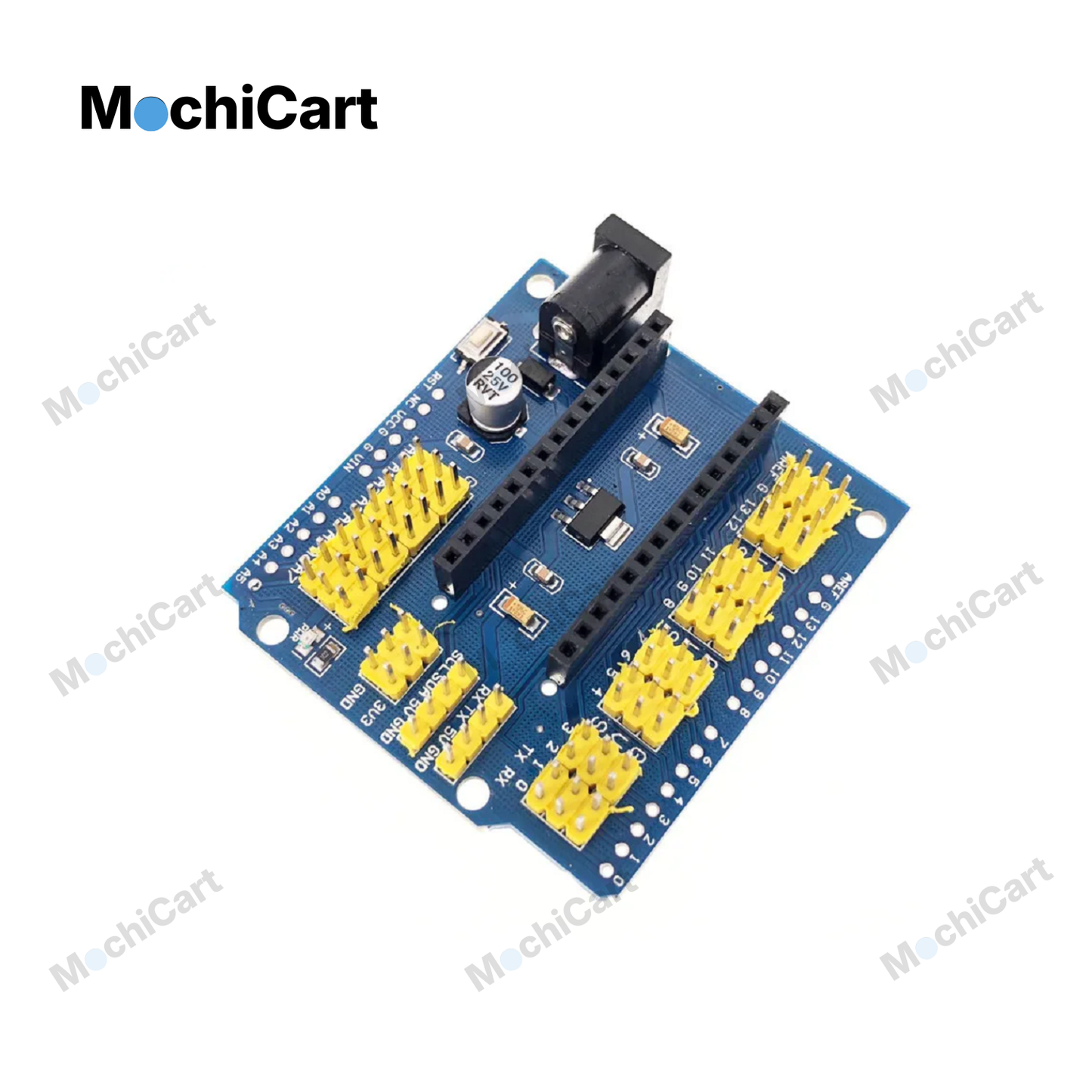
The Arduino Nano I/O Expansion Board, also known as a Sensor Shield, is designed to make working with the Arduino Nano simpler and more organized. It expands the Nano’s pin access and provides a structured way to connect sensors, modules, and servo motors. With this board, your compact Nano becomes a more powerful and convenient development platform.
Whether you are a student, hobbyist, or embedded systems developer, this expansion board makes prototyping cleaner, faster, and more reliable by reducing complicated wiring.
Main Features
1. Complete Pin Access
This shield exposes all digital and analog pins of the Arduino Nano in an easy-to-use format. Each I/O pin is arranged as a 3-pin header (Signal, VCC, GND), allowing direct connection of sensors and servos without messy jumper wires.
It includes:
- 14 Digital I/O pins
- 6 PWM output pins
- 8 Analog input pins
- I2C interface breakout
2. Built-in Power Support
The board includes onboard voltage regulation for both 5V and 3.3V, making it compatible with a wide range of electronic modules. It also features:
- Power jack input
- AMS1117 3.3V voltage regulator
- Power indicator LED
- Reset button
This setup allows you to power connected devices conveniently without needing additional external circuits.
3. Communication Interfaces
I2C, SPI, and UART communication pins are clearly labeled and easily accessible. This enables smooth integration with devices such as:
- LCD/OLED displays
- Accelerometers and gyroscopes
- Real-time clock modules
- Wireless communication modules
The organized layout helps scale your projects into more advanced systems.
4. Organized and Clean Design
The board is designed with proper spacing between headers to reduce wiring mistakes and improve clarity. This makes debugging easier and helps prevent signal interference, especially when working with sensitive analog sensors.
5. Ideal for Robotics and IoT
With multiple PWM outputs, the shield is well-suited for controlling:
- Servo motors
- Motor drivers
- ESCs
It is perfect for robotics projects like line-following robots, smart vehicles, IoT devices, and automation systems.
Technical Specifications
- Compatible with: Arduino Nano, Nano Every, Nano V3.0
- Power Input: 5V via VIN or external source
- Voltage Output: 5V and regulated 3.3V
- Interfaces: I2C, SPI, UART, PWM
- Size: 2.3″ × 2″ × 0.5″
- Compatible with Arduino UNO (after soldering headers)
Applications
This expansion board is suitable for:
- Sensor-based projects (IR, ultrasonic, gas sensors, etc.)
- Robotics development
- IoT systems using modules like ESP8266 or nRF24L01
- Home automation projects
- Educational labs and STEM learning
How It Works
The board breaks out each Nano pin into a 3-pin block (Signal, VCC, GND), allowing plug-and-play connections. Power is evenly distributed to all headers to ensure stable operation of connected components.
Communication interfaces such as I2C, UART, and SPI are also extended for quick module integration. This structured layout reduces wiring errors and improves reliability.
Who Can Use This Board?
- Beginners learning Arduino
- Students working on academic projects
- Makers building prototypes
- Engineers developing embedded systems
- Teachers demonstrating hardware interfacing
Share